
Who Made That Play? Human Attribution in Action Recognition for Sports AI
A camera can capture a goal. But can artificial intelligence identify exactly who scored it?
Imagine a football match where three players sprint towards the goal. One passes the ball, another makes a clever run, and a third delivers the winning shot.
To a human spectator, the sequence is easy to follow. But for an AI system analysing thousands of video frames, identifying the correct player behind each action is a far more complicated task.
Recognising that a goal was scored is one challenge.
Understanding who scored it, who assisted, and how the action unfolded is another.
This is where Human Attribution in Action Recognition becomes essential.
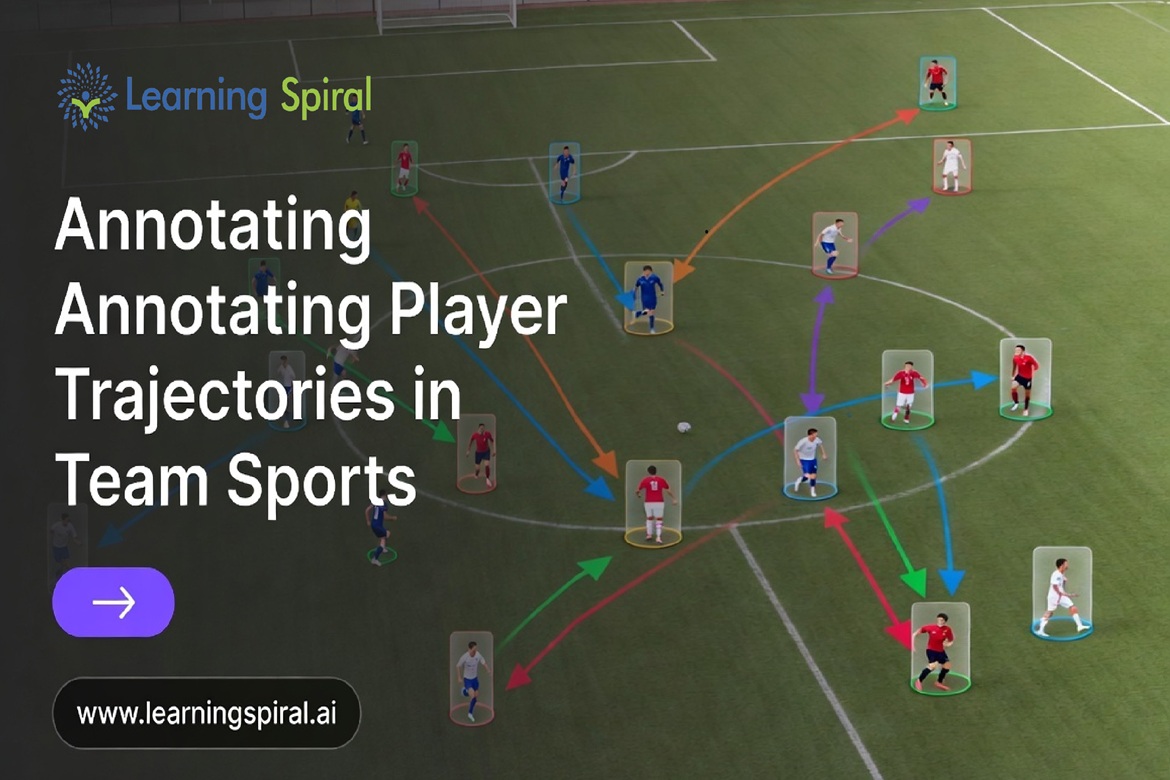
By combining Video Annotation, Image Annotation, player tracking and Human-in-the-Loop validation, sports technology companies can create structured datasets that help computer vision models connect individual athletes with specific movements and events.
Let’s explore how this works and why it matters for the future of sports analytics.
What Is Human Attribution in Action Recognition?
Human Attribution is the process of associating an observed activity or event with the correct person responsible for performing it.
In sports analytics, this means connecting an athlete’s identity or consistent tracking ID with actions such as passing, shooting, tackling, running, serving, jumping or catching.
For example, a sports AI dataset may record that Player 08 performed a pass at a particular timestamp and Player 11 received the ball a moment later.
The action label explains what happened.
The player tracking ID explains who performed it.
The timestamp explains when it happened.
Together, these labels create a richer understanding of athletic performance.
Action recognition focuses on identifying activities from observations, including sequences of human movement. Human attribution adds the actor association needed to connect those activities to specific players.
Importantly, attribution does not necessarily require facial recognition or knowledge of a player’s real-world identity. Many sports annotation systems use temporary, consistent player IDs, team labels or other permitted identifiers.
Why Sports AI Needs More Than Action Detection
A computer vision model might correctly recognise a tackle in football footage while attributing it to the wrong player.
Similarly, a basketball model might detect a successful shot but confuse the shooter with a nearby defender.
These errors affect the usefulness of subsequent performance analytics.
Sports intelligence depends on three connected questions:
What happened? Who performed it? When and where did it happen?
Accurate attribution can support player-level performance statistics, tactical analysis, action-specific video retrieval and automated match highlights.
It also enables more meaningful coaching insights because actions can be associated with the appropriate athlete rather than recorded as anonymous events.
This is one reason specialised Image annotation for sports and games is valuable when building sports-focused AI systems.
How Human Attribution Works in Sports Video Annotation
Turning raw match footage into a reliable action-recognition dataset requires several connected stages.
1. Identify Players, Objects and Relevant Equipment
The first step is recognising the elements that matter within the sports environment.
Depending on the game, annotators may label athletes, referees, balls, bats, rackets, goalposts, court boundaries and other equipment.
Bounding Box Annotation places rectangular labels around relevant objects, while polygon or segmentation methods may be used when more precise object boundaries are required.
These annotations help object-detection models distinguish players from their surroundings.
For example, a cricket dataset might require separate classes for the batter, bowler, wicketkeeper, ball, bat and stumps.
Without reliable object identification, subsequent player tracking and action recognition become more difficult.
2. Maintain Consistent Player IDs Across Frames
Once players are identified, the system needs to follow them through a sequence.
A footballer running across the pitch should not become a new object every time the camera moves.
The purpose of Video Annotation is to capture information across time, rather than treat every frame as an unrelated image.
Annotators or tracking tools can assign consistent IDs to players and objects throughout a video segment.
This supports Video tracking, in which moving objects are located and associated across consecutive frames.
However, identity consistency becomes challenging when athletes overlap, leave the camera’s view or reappear after a sudden camera cut.
Human validation can help resolve these ambiguous situations.
3. Recognise Specific Sporting Actions
After identifying and tracking athletes, the next stage involves recognising their movements and activities.
Sports action labels might include a sprint, jump, dribble, pass, tackle, serve, catch, shot or block.
The exact classes must reflect the sport and the intended machine learning application.
For example, in tennis, an annotation project might distinguish between a serve, forehand, backhand, volley and smash.
In basketball, action classes might include dribbling, passing, shooting and rebounding.
Action recognition becomes more useful when these labels are connected to the player performing the movement.
A model should learn more than the appearance of an action. It should learn the relationship between the athlete, the movement and the surrounding game context.
4. Attribute Each Action to the Correct Player
This is the central stage of Human Attribution.
Suppose a football player receives the ball, dribbles past a defender and then passes to a teammate.
The annotation record may associate three event descriptions with the relevant athletes and time intervals.
An illustrative structured record could identify:
Actor: Player_07
Action: Pass
Start Time: 00:42:15.200
End Time: 00:42:15.760
Target: Player_11
Review Status: Verified
In a production dataset, timestamps, identities and relationships must follow an approved annotation schema.
For shared actions, the schema may also distinguish between initiator, recipient, defender and other participating roles.
This distinction is important because the athlete closest to an event is not always the athlete responsible for it.
5. Label the Beginning and End of Actions
Sports actions happen over time.
A tennis serve includes preparation, ball toss, racket movement and contact. A football tackle may involve an approach, challenge and recovery.
Temporal annotation identifies where a particular action begins and ends.
This helps models learn the movement patterns associated with an activity rather than relying on a single frame.
Accurate time boundaries are particularly useful for automated highlight generation and event retrieval.
Annotation guidelines should clarify whether an event begins with the preparatory movement, the primary physical action or another defined trigger.
Without consistent rules, two annotators may label the same event differently even when they agree on which player performed it.
6. Validate Attribution Through Human Review
Automated detection can accelerate data preparation, but difficult sports footage still benefits from human judgement.
A model may confuse teammates wearing identical jerseys, lose the ball during a fast movement or assign an action to the wrong athlete after a camera transition.
Human in the Loop (HITL) brings trained annotators and reviewers into the workflow to inspect uncertain predictions and correct inconsistent labels.
Reviewers can compare neighbouring frames, examine action boundaries and confirm whether the actor ID remains consistent.
When the available evidence is insufficient, the workflow should support an uncertain or unresolved label rather than force an unsupported attribution.
This produces more dependable training examples and reduces the risk of teaching the model incorrect relationships.
The Role of Keypoint Annotation in Athlete Movement Analysis
Bounding boxes identify where an athlete is located.
Keypoint annotation helps describe the athlete’s posture and movement.
For example, a sports dataset may include labelled positions for shoulders, elbows, wrists, hips, knees and ankles.
When these keypoints are tracked across video frames, they provide structured information about movement sequences.
This is useful in applications involving running mechanics, throwing technique, jumping, posture assessment and gesture recognition.
Consider a cricket bowler.
A bounding box identifies the athlete.
Keypoints describe the positioning of body joints.
Temporal labels identify the bowling action.
Human attribution associates that action with the correct player.
Together, these annotations create training data that supports more detailed movement analysis.
However, body pose alone may not prove what happened during a game. Ball contact, other players’ movements and the rules of the sport may also be necessary to interpret an action correctly.
Why Human Attribution Becomes Difficult in Real Matches
Sports footage is significantly more complicated than controlled laboratory video.
Players move unpredictably, uniforms often look similar, and cameras may capture events from different distances or angles.
Several challenges make high-quality Data Annotation essential.
Player Overlap and Occlusion
A defender can temporarily hide an attacking player, making identity tracking difficult.
Annotation guidelines need clear rules for partially visible and fully occluded athletes.
Rapid Camera Changes
Broadcast footage frequently switches from a wide-angle shot to a close-up.
The same athlete may look very different between these views, and camera cuts can interrupt continuous tracking.
Small and Fast-Moving Objects
A cricket ball or tennis ball may occupy only a few pixels in some frames.
Motion blur, compression and rapid movement can make object localisation and event attribution difficult.
Similar Player Appearance
Athletes wearing similar uniforms may be confused during fast transitions, particularly when jersey numbers are not visible.
Complex Multi-Person Interactions
A tackle, block or contested rebound may involve multiple athletes.
Accurate attribution requires understanding the role of each participant rather than assigning the event to the nearest detected player.
Replays and Duplicate Events
Sports broadcasts often repeat important moments from different camera angles.
A dataset must distinguish repeated footage from genuinely new events so the same action is not incorrectly counted multiple times.
These challenges demonstrate why accurate Data Labeling depends on more than simply drawing boxes around players.
How Sports Analytics Benefits From Human-Attributed Data
Player Performance Analysis
Human-attributed datasets can help train systems that associate passes, tackles, shots and other movements with individual players.
Once models are appropriately validated, their outputs may support performance reporting and coaching analysis.
Tactical Intelligence
Tracking player positions and attributed activities helps analytical systems study movement patterns, team formations, passing relationships and positional changes.
Automated Sports Highlights
Action labels and event timestamps can help identify relevant moments in long sports recordings.
Attribution allows these events to be associated with the correct participating athletes.
AI-Assisted Officiating
Specialised models may support the analysis of relevant movements and events, although official decisions require appropriate rules, validated systems and human oversight.
Athlete Training and Development
Movement datasets can help support systems that examine posture, technique and repeated athletic actions.
These capabilities are especially relevant to sports technology companies building computer vision tools for coaching, training and performance analysis.
Building a Reliable Sports Action Recognition Dataset
An effective Dataset for Machine Learning should contain more than large quantities of labelled footage.
It should represent the types of situations the model will encounter after deployment.
For sports projects, this may include multiple camera angles, different stadium environments, changing light conditions, varied athlete appearances, crowded situations and unusual actions.
Annotation teams should establish consistent class definitions, player-ID rules, temporal boundaries and review procedures before scaling production.
Quality assurance should examine whether objects are correctly labelled, identities remain consistent, actions are assigned to the correct actors and event timestamps follow the project specification.
Model evaluation should also use appropriately separated training and test data. For example, preventing closely related footage from the same match from leaking across splits can make performance assessments more meaningful.
If datasets contain identifiable participants, organisations should also consider consent, data usage rights, retention policies and access controls.
The goal is not merely to produce more labelled data. It is to create reliable examples that reflect real-world sporting conditions.
Beyond Traditional Sports Footage: Egocentric and Spatial Data
Not every sports AI application uses broadcast video.
Some training environments use wearable cameras or first-person footage to study how an athlete sees and responds to a situation.
Egocentric Data Collection can support these use cases by capturing visual information from the participant’s perspective.
For example, first-person footage may help a training application analyse what an athlete could see during a particular movement or decision.
Advanced sports environments may also incorporate depth information, LiDAR Annotation or 3D Point Cloud Annotation where suitable sensors are available.
These methods can provide additional spatial context for specialised tracking and motion-analysis applications.
However, the most appropriate annotation technique depends on the project’s actual data, model architecture and intended outputs.
How Learning Spiral AI Supports Sports Action Recognition
Sports AI models need trustworthy data to learn meaningful relationships between athletes, objects and actions.
Learning Spiral AI, the AI data solutions division of Learning Spiral Ltd., provides Data Labeling and Data Annotation Services for computer vision and machine learning projects.
Our teams support sports-focused annotation requirements through Image Annotation, Video Annotation, Bounding Box Annotation, player and object tracking, keypoint labeling, activity tagging and human-reviewed quality workflows.
These capabilities can help developers prepare structured AI Training Data Services for applications involving player tracking, action recognition, match-event detection, tactical analysis and automated highlights.
As a Data Annotation Company and Data Labeling Company in India, Learning Spiral AI combines trained annotation resources with project-specific instructions and structured validation processes.
Our broader capabilities also include Audio Annotation, Text Annotation, LiDAR Annotation, 3D Point Cloud Annotation, Image Annotation for Robotics and other specialised AI Data Solutions.
These services support organisations working across sports, autonomous vehicles, healthcare, retail, logistics, agriculture, physical AI and other computer vision applications.
For sports-focused annotation projects, our objective is straightforward: help AI models learn not only what happened in a game, but which athlete was responsible for the action.
Frequently Asked Questions
What is human attribution in sports action recognition?
Human attribution associates a detected action with the correct athlete or participant. It connects activity labels, player identities or tracking IDs, and timestamps within a structured sports dataset.
How is human attribution different from human action recognition?
Action recognition identifies the activity being performed, such as running, jumping or passing. Human attribution identifies which observed participant performed that activity.
Why is Video Annotation important for sports analytics?
Video Annotation captures player identities, actions and movements across consecutive frames. It supports the development of models that analyse athletic activities over time.
Which annotation methods support player attribution?
Depending on the task, projects may combine Bounding Box Annotation, object tracking, keypoint annotation, segmentation, temporal labeling and human validation.
Does human attribution require facial recognition?
Not necessarily. Annotations can use persistent player tracking IDs or other permitted identification methods. Real-world identity recognition is a separate requirement that may not be needed.
Can AI automatically identify every sports action correctly?
No system should be assumed to perform perfectly across all conditions. Occlusion, camera cuts, ambiguous interactions and unfamiliar scenarios can affect accuracy. Representative datasets, testing and Human-in-the-Loop review help improve reliability.
Conclusion: Sports AI Must Understand Who, Not Just What
The future of sports analytics depends on systems that understand more than isolated movements.
A successful AI model should be able to connect the right athlete with the right action at the right moment.
That requires accurate object detection, consistent player tracking, meaningful action labels, temporal context and reliable human validation.
Human Attribution in Action Recognition transforms sports footage from a sequence of visual events into structured information that supports player-level intelligence.
For sports technology developers, broadcasters, researchers and analytics platforms, high-quality data annotation is an important foundation for building that capability.
Build Better Sports AI With Learning Spiral AI
Developing a sports analytics platform, player-tracking system or action-recognition model?
Partner with Learning Spiral AI, for scalable, human-reviewed data annotation and labeling solutions tailored to your AI project.