
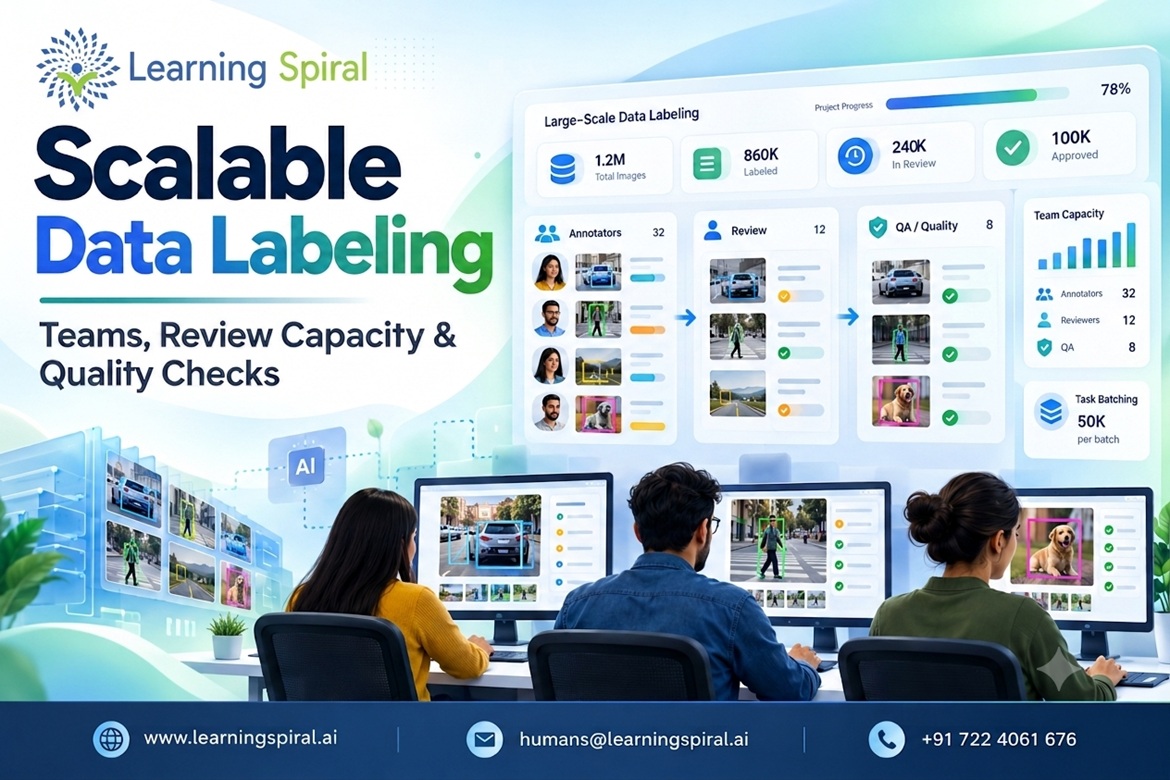
Deploying production-grade machine learning models requires high volumes of precisely tagged data. As computer vision, natural language processing (NLP), and multimodal AI systems advance, managing enterprise-scale projects becomes an operational hurdle. Navigating workforce scaling, consensus validation, and rigorous quality control is critical to long-term success. Discover how structured team planning, review capacity management, and multi-tier quality checks ensure successful, high-accuracy execution for large-scale annotation initiatives.
1. Strategic Team Planning for Large-Scale Data Labeling
Scaling a data annotation campaign involves more than expanding team headcount; it requires establishing structured workflows, clear taxonomy definitions, and specialized domain expertise. Whether deploying bounding box annotation for retail analytics or domain-specific medical data annotation, proper team alignment forms the foundation for reliable dataset generation.
- Core Annotators: Domain-trained specialists executing line-item labeling (e.g., 2D/3D polygons, keypoint tracking, or semantic segmentation).
- Quality Assurance (QA) Auditors: Senior annotators who review labeled outputs against guidelines to catch edge-case discrepancies early.
- Project Managers & SME Leaders: Operational leaders managing throughput velocity, client feedback loops, and dynamic guideline adjustments.
When executing complex initiatives such as Lidar Annotation or physical AI data collection, matching workforce domain knowledge with project complexity prevents systemic error propagation.
2. Managing Review Capacity & Human-in-the-Loop (HITL) Workflows
A frequent bottleneck in large-scale machine learning data pipelines occurs during the quality review phase. Scaling annotation volume without proportional review infrastructure leads to audit backlogs and delayed model retraining cycles.
Integrating a structured Human-in-the-Loop (HITL) framework allows AI engineering teams to maintain high precision without sacrificing speed:
- Tiered Sampling Rates: Initial project phases start with a 100% review protocol. As annotator benchmark scores stabilize above target thresholds (e.g., >98% accuracy), systems transition to randomized 15%–20% statistical audit sampling.
- Consensus & Inter-Annotator Agreement (IAA): For ambiguous datasets—such as egocentric data collection or complex sentiment analysis—multiple annotators independently label identical samples to resolve edge-case variance through majority voting mechanisms.
- Dynamic Re-Queueing: Unapproved data items are automatically flagged, routed back to original annotators with contextual feedback, and re-submitted to maintain continuous learning loops.
3. Multi-Tiered Quality Control Mechanisms
To deliver enterprise-grade datasets across industries—ranging from image annotation for autonomous vehicles to audio data annotation—leading service providers implement a rigorous multi-tier quality pipeline:
- Automated Pre-Processing & Syntactic Validation: Real-time software checks catch basic spatial overlaps, missing tags, and unformatted metadata before human review.
- In-Line Manual Audits: Dedicated QA leads perform itemized precision scoring using standardized IoU (Intersection over Union) metrics for visual tasks.
- Final Acceptance Sampling: Comprehensive statistical batch audits ensure the delivered dataset fully aligns with client specification requirements.
For specialized industries needing Image Annotation Services or custom Data Labeling Services, robust quality assurance ensures training data directly improves real-world model accuracy.
Partnering with Established Annotation Specialists
Scaling data pipelines in-house often strains internal engineering bandwidth and infrastructure budgets. Partnering with professional Data Annotation Companies in India provides scalable infrastructure, certified ISO data security compliance, and trained human-in-the-loop teams tailored to your project requirements.
Whether managing large-scale 3D point cloud annotation, content moderation, or specialized text data annotation, structured workforce planning guarantees reliable AI deployment at scale.