
What This Article Covers
- Agricultural image annotation use cases
- Annotation methods and workflow
- Manual versus AI-assisted labeling
- Dataset quality challenges
- FAQs for agriculture AI teams
What Is Image Annotation for Agriculture?
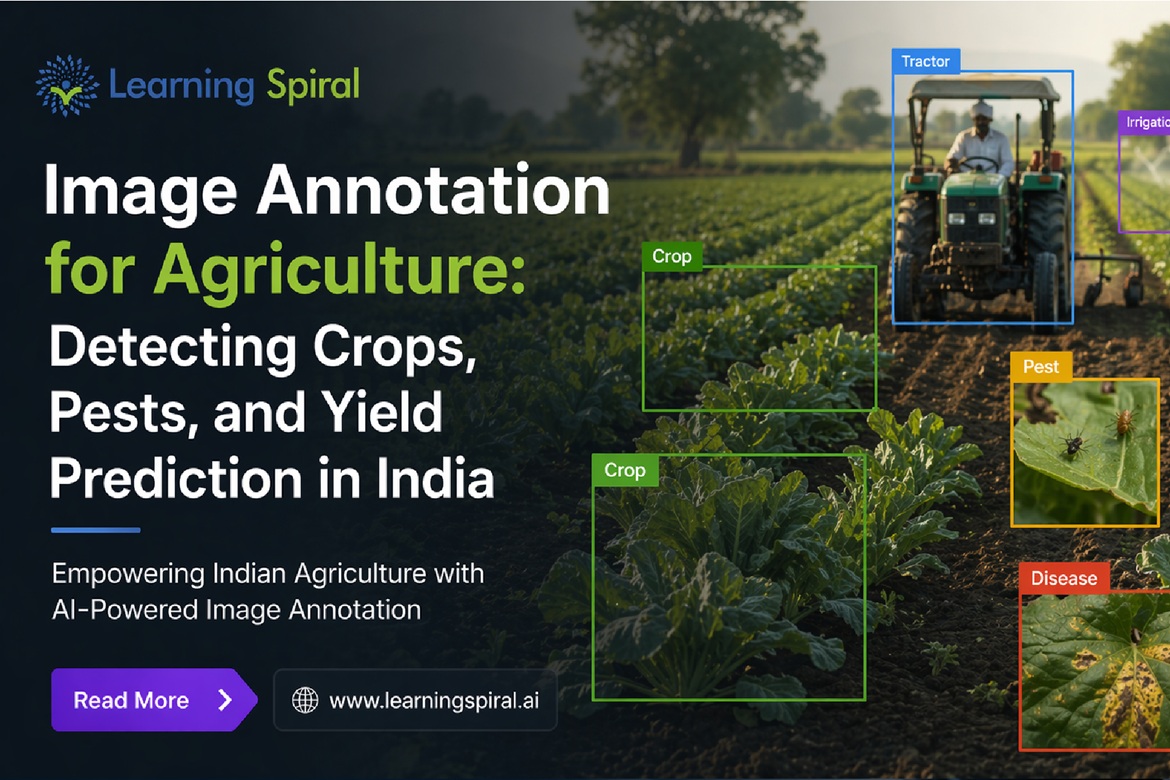
Image annotation for agriculture is the process of labeling crops, weeds, pests, diseases, fruits, field boundaries, and soil conditions in photographs, drone imagery, or satellite data. These labels create a Dataset for Machine Learning, enabling computer vision models to detect agricultural objects, assess crop health, and support yield prediction.
FAO sources identify pest diagnosis, crop-yield prediction, irrigation planning, and soil mapping as important applications of AI in agriculture.
How Agricultural Image Annotation Supports AI
- Crop detection: Bounding Box Annotation identifies individual plants, fruits, or crop rows.
- Pest and disease detection: Classification and segmentation label insects, lesions, discoloration, and damaged leaves.
- Crop–weed separation: Pixel-level Image Labeling helps autonomous machines distinguish crops from weeds.
- Aerial field analysis: Image Annotation for aerial imagery maps field boundaries, vegetation stress, and crop coverage.
- Yield prediction: Annotated fruit counts, canopy density, growth stages, and historical imagery improve forecasting inputs.
India-built agricultural AI systems already use imagery for field segmentation, crop classification, and pest-count analysis.
Manual vs AI-Assisted Annotation
| Factor | Manual Annotation | AI-Assisted + HITL |
|---|---|---|
| Accuracy | Strong but slower | Scalable with human review |
| Complex boundaries | Highly precise | Requires correction |
| Large datasets | Resource-intensive | Faster processing |
| Best use | Specialist cases | Large Annotation Projects |
A reliable workflow combines automated pre-labeling with Human in the Loop (HITL) validation and agronomy-specific quality checks.
Building Reliable Agricultural Datasets
Successful Data Annotation Projects require regional crop varieties, different growth stages, changing light, weather conditions, camera angles, and genuine field backgrounds. Clear annotation guidelines should define object classes, occlusion rules, disease severity, and acceptable uncertainty.
Learning Spiral AI delivers scalable Image Annotation Services, Data Labeling Services, Video Annotation, Lidar Annotation, and AI Training Data Services for computer-vision applications. High-quality annotation is not just data—it is the foundation of reliable AI systems.
FAQs
Which annotation method is best for crop detection?
Bounding boxes suit object detection, while semantic or instance segmentation supports precise crop–weed separation.
Can image annotation detect plant diseases?
Yes. Annotated symptoms help models classify diseases and locate affected plant regions.
How is annotation used for yield prediction?
Models learn from labeled fruit counts, crop density, maturity stages, and aerial patterns.
Why does Indian agricultural data need local annotation?
Crop varieties, field layouts, climate, soil, and visual conditions vary significantly across regions.
How do I choose an Image Annotation Company?
Evaluate domain expertise, quality controls, security, scalability, HITL processes, and support for complex agricultural datasets.
Explore Agricultural AI Data Solutions
Explore Learning Spiral AI’s reliable data labeling and image annotation services or connect with the team to build deployment-ready agricultural training data.