
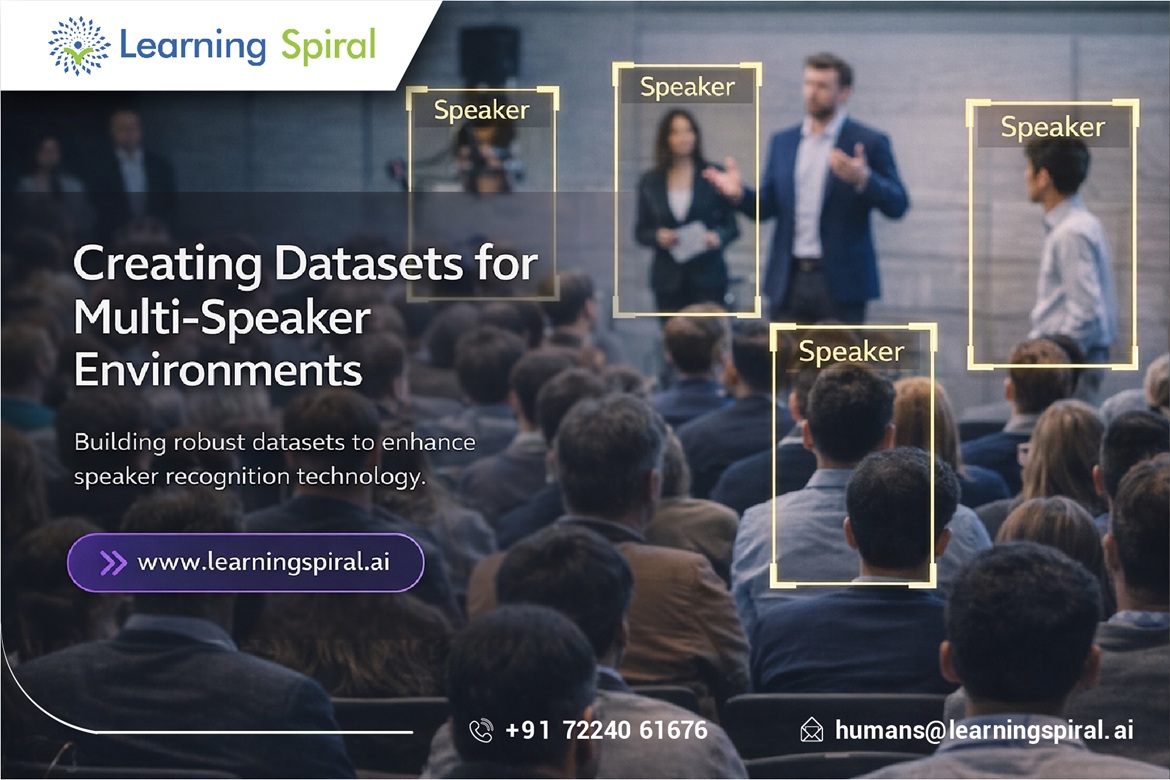
Why Multi-Speaker Datasets Matter in AI
AI systems are no longer trained only on clean, single-speaker audio. Today, voice assistants, call center analytics, meeting transcription tools, healthcare documentation systems, and security applications need to understand conversations involving multiple speakers.
This is where multi-speaker datasets become essential. They help Machine Learning datasets capture real-world speech patterns such as interruptions, accents, background noise, emotional tone, and speaker overlap.
High-quality annotation is not just data – it’s the foundation of reliable AI systems.
The Key Challenge: Separating Voices Accurately
Creating datasets for multi-speaker environments is complex because audio is rarely perfect. People may speak at the same time, use different languages, or talk from varying distances.
A strong AI Data Solutions approach usually includes:
- Speaker diarization to identify “who spoke when”
- Audio annotation for speech segments, pauses, and noise
- Text annotation for transcripts, intent, and context
- Data labeling for speaker roles, emotions, and conversation flow
- Quality checks to reduce transcription and tagging errors
Without accurate Data labeling, AI models may confuse speakers, miss important context, or produce unreliable outputs.
Where Multi-Speaker Data Is Used
Multi-speaker datasets support several AI and industry applications, including:
- Contact center automation
- Meeting and lecture transcription
- Voice-based healthcare tools
- Smart surveillance systems
- Conversational AI assistants
- Compliance and sentiment analysis
In some use-cases, audio data may also connect with Video annotation and Computer Vision workflows, especially when models need to understand speech, facial expressions, gestures, and human activity together.
Building Datasets with Accuracy and Scale
A reliable Data Annotation Company must combine trained annotators, clear guidelines, domain understanding, and strong review processes. This ensures that datasets remain consistent even when audio quality, speaker count, or language complexity changes.
Learning Spiral AI works with structured annotation workflows designed for scalable AI data preparation. Along with Audio annotation, its broader capabilities across Image Annotation Services, Video annotation, and Text annotation help organizations build complete, model-ready datasets.
Multi-speaker datasets are critical for AI systems that need to understand real conversations, not just controlled recordings. Organizations working with experienced AI data solution partners often achieve faster model accuracy and smoother deployment.
To build reliable AI systems with cleaner, better-labeled datasets, explore Learning Spiral AI’s annotation and data labeling services.